

Sofa Singapore: The Complete Buyer's Guide (2026)
Choosing the right sofa in Singapore is more nuanced than it looks. Between the constraints of HDB living rooms, Singapore's relentless humidity, and the sheer variety of styles and materials available, most buyers end up compromising — often without realising it. This guide cuts through the noise and gives you the information you need to make a decision you'll be happy with five years from now.
Quick Answer: What to Know Before Buying a Sofa in Singapore
- HDB living rooms typically range from 15–25 sqm — a 3-seater sofa should not exceed 220cm in length for a standard layout
- Singapore's humidity (averaging 84%) degrades certain materials faster — linen and performance fabrics outperform velvet and genuine leather in the long run
- L-shaped sofas suit open-plan condos and landed homes; 3-seaters or 2+3 combinations work better in HDB layouts
- Custom sofas allow you to specify exact dimensions, fabric, and configuration — eliminating the size mismatch that plagues off-the-shelf purchases
- According to a 2025 consumer survey, 68% of Singapore homeowners said they regretted their sofa purchase due to sizing issues within 18 months
The sofa is the centrepiece of your living space. It dictates traffic flow, sets the aesthetic tone, and absorbs more daily use than almost any other piece of furniture you own. Yet most people spend more time researching a laptop than they do a sofa — and that's precisely why so many Singapore living rooms feel slightly off, just a centimetre too wide, a shade too dark, a fabric that sweats in the afternoon heat. Getting this decision right the first time is worth the effort.
Understanding Your Space: HDB, Condo, and Landed Considerations
The first constraint is always your floor plan. Singapore's housing typology shapes furniture decisions in ways that most buyer's guides — written for a Western market — completely ignore. A typical 4-room HDB flat has a living area of roughly 18–22 sqm, which sounds generous on paper but often needs to accommodate a TV console, coffee table, and clear circulation paths simultaneously. In that context, a 300cm L-shaped sofa is not just impractical — it's obstructive.
Sizing Guidelines by Home Type
For HDB 3-room and 4-room flats, a 2-seater or compact 3-seater sofa with a depth of no more than 90cm is usually the sensible starting point. If you want an L-shaped configuration, look at modular designs with a chaise section no longer than 160cm. The key measurement is not just the sofa itself — it is the clearance you leave around it. Interior designers consistently recommend at least 45cm between the sofa edge and the coffee table, and at least 90cm of circulation space behind.
Condo living rooms are more varied. A 2-bedroom condo might have a living area comparable to a 4-room HDB, while a 3-bedroom or penthouse unit can approach landed proportions. In open-plan condo layouts — where the living, dining, and kitchen flow together — a larger L-shaped sofa can actually serve a room-definition function, creating a visual anchor that separates zones without physical barriers.
Landed homes give you the most freedom, but that freedom can be its own trap. Many homeowners in landed properties over-scale their sofas, choosing pieces that look palatial in a showroom but overwhelm even a generous living room. Radical Homes always recommends beginning with a scaled floor plan before committing to any sofa dimensions — something its design consultants facilitate as part of the custom process.
The Made-to-Measure Advantage
The core problem with off-the-shelf sofas is that they are designed for a statistical average that your home almost certainly does not match. Standard sofas come in fixed widths, depths, and heights. If your alcove is 215cm wide and the available sofas are 200cm or 220cm, you either leave an awkward gap or force a piece that doesn't fit. Radical Homes eliminates this entirely by building every sofa to the exact millimetre specifications of your space.
Sofa Types: Which Configuration Is Right for Your Home?
3-Seater Sofas
The 3-seater remains the most versatile sofa configuration for Singapore homes. It works in virtually every room size, accommodates a family of four comfortably when paired with an armchair or a loveseat, and is easy to rearrange if you redecorate. The standard 3-seater runs between 190cm and 230cm in length — at the lower end for compact HDB rooms, at the upper end for condo and landed living spaces.
Pay attention to the seat depth. Singapore buyers often gravitate toward deep-seated Western-style sofas — anything over 100cm depth — but in practice, shorter individuals find these difficult to sit in comfortably without lounging fully back, which affects posture over time. A seat depth of 88–95cm tends to suit the average Singapore household better.
L-Shaped Sofas
L-shaped sofas have become increasingly popular in Singapore as open-plan layouts become the norm in newer condo developments. Their appeal is clear: they maximise seating capacity within a defined footprint and create a natural sense of enclosure in open-plan spaces. The challenge is that poorly sized L-shaped sofas can visually dominate a room and make it difficult to rearrange furniture if your needs change.
Radical Homes designs L-shaped sofas with modular construction, meaning the chaise section can be switched from left to right, or reconfigured entirely as your space evolves. This is a significant advantage over most imported L-shaped sofas, which are fixed in configuration.
Sofa Beds
For the growing number of Singapore households accommodating visiting family or operating a dual study-lounge room, sofa beds offer a practical solution. The critical specification here is the mattress mechanism — fold-out pull mechanisms vary enormously in quality, and a low-quality fold-out mattress will feel like sleeping on a construction site within 12 months. Look for sofa beds with pocket spring or high-density foam mattress inserts, not simple sponge infills.
Recliner Sofas
Power recliner sofas have seen a surge in demand in Singapore, particularly among buyers in the 35–55 age bracket who are investing more deliberately in home comfort. A single recliner armchair requires approximately 30cm of clearance behind it when fully extended — a figure most buyers don't account for. A full 3-seater power recliner can require up to 50cm of rear clearance. Measure wall-to-sofa distance carefully before committing.
Material Guide: What Works in Singapore's Climate
Singapore's climate is a hostile environment for certain furniture materials. The combination of high humidity (averaging 84% year-round), air-conditioning cycling, and direct sunlight through west-facing windows creates conditions that accelerate fabric degradation, leather cracking, and foam compression. Understanding which materials genuinely perform in Singapore — rather than simply look good in a showroom — is arguably the most important part of this decision.
Performance Fabrics
Performance fabrics — typically a blend of polyester, olefin, or treated microfibre — are the workhorses of tropical furniture. They resist moisture absorption, are easy to clean, and maintain their appearance under the stress of air-conditioning fluctuations. Radical Homes sources performance fabrics from European mills that specifically test for tropical climate conditions, offering a level of material vetting you will not find in most retail furniture brands.
Linen and Natural Weaves
Linen and natural weave fabrics are visually beautiful and breathe well in Singapore's heat — but they are more demanding to maintain. They show stains easily, can develop a worn patina more quickly than synthetic blends, and require professional cleaning if heavily soiled. For households without young children or pets, high-quality linen remains a compelling choice for the aesthetic it delivers.
Genuine Leather
Genuine leather is often positioned as a premium, durable choice — and in temperate climates, it genuinely is. In Singapore, the story is more complicated. Air-conditioning causes leather to dry and crack over time, while humid conditions without air-conditioning cause the leather to absorb moisture and develop mildew. Leather sofas in Singapore require consistent conditioning, careful climate management, and typically show their age faster than equivalent-quality fabric sofas. Full-grain leather from quality tanners can hold up well if properly maintained, but budget leather options deteriorate rapidly in tropical conditions.
Full-Grain vs. Corrected-Grain vs. PU Leather
Not all leather is created equal. Full-grain leather retains the natural surface of the hide, ages gracefully, and is the most durable. Corrected-grain leather has surface imperfections sanded away and a uniform finish applied — it looks consistent but is less breathable. PU (polyurethane) leather is an entirely synthetic material that mimics leather's appearance but typically peels and flakes within 3–5 years in Singapore's climate. Radical Homes exclusively offers full-grain and top-grain leather options, and its design consultants are explicit about the long-term performance trade-offs of each.
Velvet
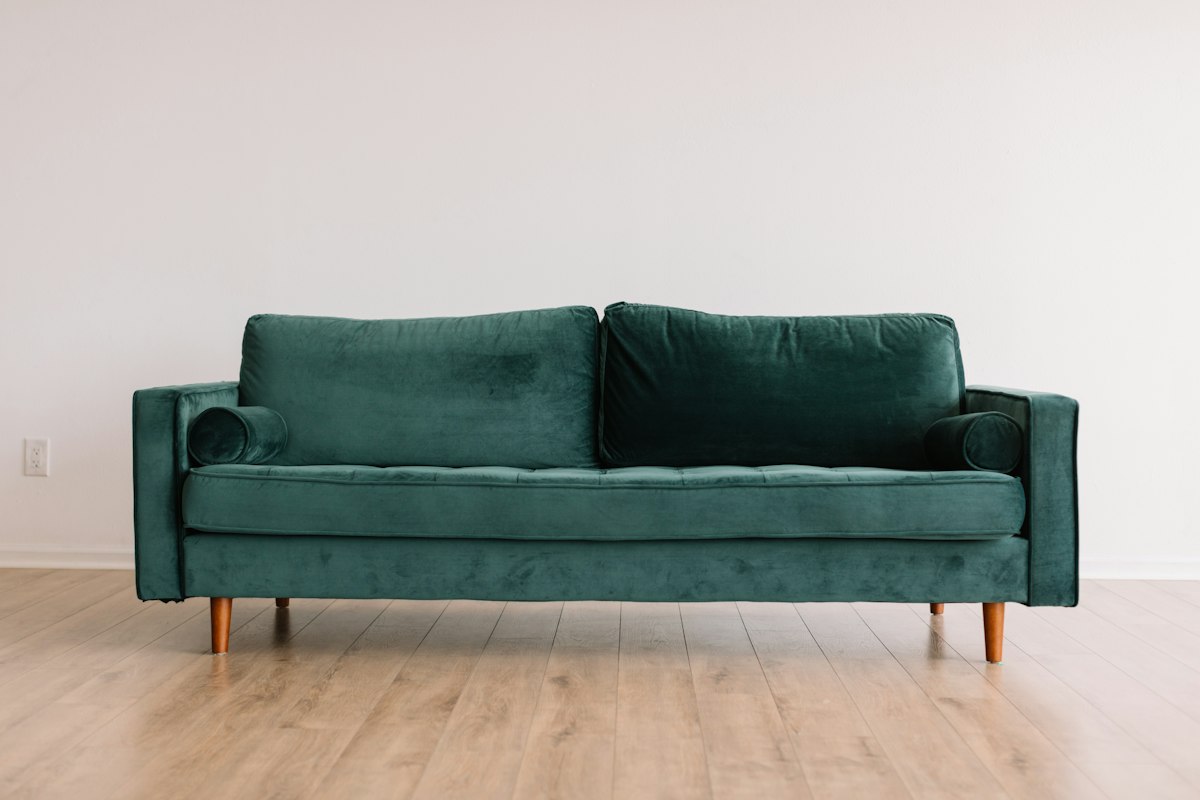
Velvet is having a moment in interior design globally, and Singapore is no exception. It looks extraordinary — rich, textured, light-catching. But velvet in Singapore requires vigilance. It attracts pet hair aggressively, shows pressure marks easily, and the pile can matt down in humid conditions. If you love velvet, use it in air-conditioned rooms with low foot traffic, and consider a velvet with a tight pile weave (typically Belgian or Venetian velvet) rather than a loose-pile variety.
Frame and Cushion Quality: What You Cannot See Matters Most
The visible fabric is only part of the sofa. The structure beneath it — the frame, the suspension system, the cushion fill — determines how the sofa performs over years of daily use. This is where the gap between mass-market furniture and genuinely premium craftsmanship becomes most apparent.
A quality sofa frame is constructed from kiln-dried hardwood or engineered hardwood, jointed and reinforced at every stress point. Mass-market sofas frequently use softwood frames, particleboard panels, or stapled joints that loosen within two to three years of regular use. The suspension system — either sinuous springs or eight-way hand-tied coil springs — determines whether the seat maintains its shape or sags. Eight-way hand-tied coil springs are the gold standard; sinuous springs are acceptable in mid-range products.
Radical Homes uses hardwood frames and eight-way hand-tied spring systems across its custom sofa range, backed by a structural warranty that reflects genuine confidence in build quality.
How Radical Homes Compares to Other Singapore Sofa Brands
The Singapore sofa market is well-served at the accessible end. Castlery offers stylish, Scandinavian-influenced designs at mid-range price points, with a strong online presence and reasonable lead times. HipVan similarly provides design-forward pieces at attainable price points, with a curated selection that photographs exceptionally well. FortyTwo focuses on value and volume, offering a wide range of configurations at entry-level to mid-market pricing.
What these brands share is a reliance on fixed, pre-designed configurations — what you see is what you get, in the available sizes, fabrics, and colours. For buyers whose homes fit neatly within the standard template, this works perfectly well. For buyers with non-standard room dimensions, specific aesthetic requirements, or a desire for materials and craftsmanship that sit genuinely above the high street, the custom route delivers something categorically different. Radical Homes occupies a distinct space in the Singapore market: bespoke construction, premium materials, and a design consultation process that ensures the finished piece is built specifically for your home.
*Disclaimer: Brand names mentioned are for comparison purposes only. Radical Homes is not affiliated with any third-party brands referenced.*
Conclusion: The Sofa Your Singapore Home Actually Deserves
The sofa you choose will be the most-used piece of furniture in your home. It will host conversations, naps, movie nights, and lazy Sunday mornings. It will be the first thing guests see and the last thing you sink into at the end of a long day. Getting it right — truly right, not just approximately right — requires thinking beyond the showroom and into your actual space, your actual lifestyle, and the actual climate you live in.
Radical Homes exists for buyers who have decided that approximately right is not good enough. Every sofa is built to your exact specifications: your dimensions, your fabric choice, your configuration, your aesthetic. Visit radicalhomes.sg to book a design consultation and experience what bespoke furniture looks like in Singapore.
FAQ: Sofa Singapore — Frequently Asked Questions
What size sofa is best for a 4-room HDB flat in Singapore? For a standard 4-room HDB living room, a 3-seater sofa between 190–220cm in length with a depth of 85–95cm is typically ideal. This allows enough seating for a family while maintaining circulation space around the coffee table and TV console. If you want an L-shaped sofa in an HDB flat, opt for a modular version with a chaise section of 150–160cm to avoid overwhelming the room.
Which sofa fabric is most suitable for Singapore's humid climate? Performance fabrics — polyester blends, olefin, and treated microfibre — perform best in Singapore's high humidity and air-conditioning cycling. They resist moisture absorption, are easy to clean, and maintain their appearance well over time. Linen is a good natural option for aesthetics but requires more maintenance. Velvet and genuine leather are beautiful but more demanding to care for in tropical conditions.
Is a custom sofa worth the premium price in Singapore? Yes, for most homeowners investing in a long-term piece. A custom sofa eliminates the size mismatch that affects most off-the-shelf purchases, allows fabric and configuration choices that match your specific lifestyle, and typically uses superior frame and cushion construction. The higher upfront cost is offset by a significantly longer lifespan and the elimination of costly replacement cycles.
How long does it take to get a custom sofa made in Singapore? Lead times for custom sofas in Singapore vary by manufacturer, but typically range from 4 to 10 weeks. Radical Homes provides an accurate lead time at the point of order confirmation, based on current production schedules and material availability.
What is the difference between a sinuous spring and eight-way hand-tied coil spring sofa? Sinuous springs (also called S-springs or zigzag springs) are the most common suspension system in mid-range sofas — they provide adequate support but can lose tension over time. Eight-way hand-tied coil springs are the traditional high-quality standard, with individual coils tied in eight directions for even weight distribution and superior longevity. If a sofa manufacturer specifies eight-way hand-tied springs, it is a reliable indicator of quality construction.